Welcome to Wish-Hound

Welcome to the Wish-Hound blog, random thoughts, random reviews, arts, literature, music, history, politics, film.

Friday, 25 October 2013

A Walk In The Lawns


Feeding ducks in the park, and wishing you were far away...
I've been averaging a blog a year up until now and here we are with a second in two weeks. What's going on? I'll put it down to the unseasonably mild weather coupled with the opportunity offered by another free Friday morning to take a stroll - soaking up the sunshine, kicking the leaves and looking up and around again at the canvas nature and humankind has provided us with over the years in dear old Swindon.
Old is the right word as today the warm autumn sunshine drew me to Old Town and a walk around the grounds of the once grand Lawns estate, once Swindon's very own Downton Abbey, home of the Goddard family, lords of the manor until Major Fitzroy Pleydell Goddard, who died in 1927, neglected certain important issues, notably his own, and failed to continue to family line.  When his widow left the property a few years later it fell into disrepair, was briefly occupied by British and American military during the Second World War. 


Sunken Garden
Swindon being Swindon this particular property was then neglected to the point of no return (familiar story?) and demolished in the early 1950s leaving us with just a few tantalising architectural hints of just what a jewel in Old Town's crown this could have been.
Gazebo, Lawns Estate
Holy Rood Church
These days the Lawns is a much needed public open space in the heart of Old Town, the footpaths, trees and lakes and grounds of the old estate punctuated with the architectural reminders of its rather grand past.


In the old days they used to refer to the lofty position (geographically and socially) of the Goddard Estate  as "Nob Hill", the latter day social commentator who obliterated this information board with his or her 'tag' seems intent on maintaining the validity of that sobriquet, albeit for slightly different reasons.


A less welcome modern day "punctuation" grabs my attention as I glance at the resplendent trees - there amongst the autumnal shades of the turning leaves - a small plastic bag hanging from a branch catches the light - a shimmering and small reminder of the unerring ability of humans to bugger up the natural environment.


Looking towards High St, Old Town
As I walk back to the High Street I notice the mock tudor exterior of the Hermitage Nursing Home. This relatively new building stands near the same spot as the original Hermitage a much grander and more interesting building that (here we go again) was left to decay to the point where demolition became the (allegedly) only viable solution - the new building no doubt serves its noble purpose very well but architecturally it is a very faint echo of yet another architectural gem Swindon could ill afford to lose that somehow it did - same as it ever was -


only one thing to do now head off into the New Old Town - there's a chocoberry juice with my name on it waiting for me at The Core ... 


Friday, 18 October 2013

A Swindon Walk About

I try to stand up for Swindon in the face of the frequent put-downs as the nation's favourite comedy town - the instantly understood short-hand reference of stand-up comedians across the land for all that is ordinary, naff and culture-free.

Truth is Swindon is not a cultural desert, and never has been in my experience. I've always found plenty of things to do in Swindon over the years, usually, it has to be said, on the small to medium scale lacking as it still does a large concert hall venue or large theatre, with the Wyvern capacity only around 700.

Swindon gets a bad press much of it undeserved, and yet ... and yet... today I went to Whalebridge practice for my annual 'flu jab, and unusually was able to get this done with no queuing. I had an unexpected hour of parking to use up so decided to walk around the town centre for a while trying to look with a visitor's eye at the early evidence appearing on the horizon of some of the much delayed re-development of the town centre. I have to say as I started out it was not a particularly inspiring walk.

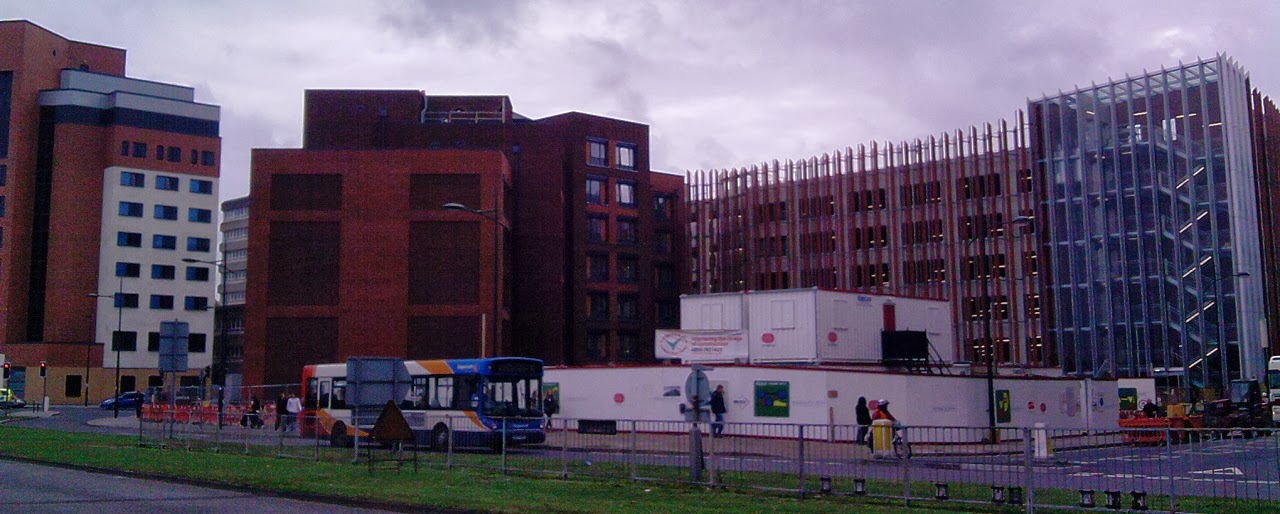
Starting out from the Whalebridge area and the new Kimmerfields development - initially dubbed Union Square in the original master plan for the long-term re-development of Swindon - the original idea being for this part of town to be a pedestrian-friendly urban space now sadly sidelined and replaced by the predictable temple to the motor-car with a brand-spanking new multi-storey car park.  The whole area around this part of town is rather dispiriting to walk around - bland blocks of concrete, glass and featureless brickwork, no discernible originality of design, or indeed purpose -  could be flats, could be office blocks, could be a warehouse - who knows - no redbrick dreams to be woven here sadly. Actually too bland to be deemed ugly, the best that can be said is it is no worse than that we have come to expect from the architects and planners who seem to have held sway in Swindon for many post-war decades now. I am pretty sure it is this ugly urban exterior particularly in the centre of town that has served Swindon and it's population so badly over the years. It is reflected in the lost and neglected architectural gems we have suffered over the years, the Hermitage, The Baptist Tabernacle, The Locarno and The Mechanics Institute. A sad architectural litany displaying a lack of civic leadership over many years,  a lack of pride in our history, a lack of respect for past, present and future generations of Swindonians, a rather tragic failure to understand the importance to our well-being of the urban environment we all share.


As I head on through the under-pass to the Parade past the proliferating coffee shops and boarded-up shop fronts it seems we've given up shopping to drink coffee instead. This could be any town in the UK of course, and this in many ways has been Swindon's claim to fame over the years, particularly amongst social scientists - Swindon has often been seen as the quintessentially average English town, in terms of demographics and economy. Though this used to be the case it is maybe not so true over recent years with Swindon salaries on average now being amongst the lowest in the country. The economic downturn following the financial crisis of 2007-8 and the resulting recession hit plans for a number of re-development projects just as plans were about to be turned into reality. Finally though here we are late  in 2013 and some of the plans are starting to move from drawing board to reality.

The white frame of the new Regent Circus development is now taking shape and will eventually house a new 7-screen cinema, restaurants and supermarket and will probably be crucial to the much needed re-generation of the town centre and the night-time economy. It should hopefully help to transform the centre of Town which for too long in the evenings has been a no-go zone for families and those unwilling to negotiate the vomit and vehemence emerging from the binge-drinking outlets that previously dominated the bottom end of town.

Before heading back down Princes Street a detour into Theatre Square and a little example and reminder of the hidden beauty of Swindon - the artsite studios that reflect the community-led culture that is really Swindon's best-kept secret. There is a very vibrant artistic community in Swindon much of the best things community-led or the result of the driving passion of a few committed individuals. Swindon Bluegate Poets, Swindon Festival of Literature, Swindon Film Society Festival, Old Town Jazz festival, the annual original musical extravaganza that is the Swindon Shuffle being just a few examples. With many active visual artists, musicians, writers and poets in Swindon things are looking up in many ways - and just up the hill Old Town has been thriving over recent years with new start up businesses, new bars, cafes, food halls etc. Hopefully the re-development now starting in the "New" town will see similar regeneration there.  In the meantime Swindon and Swindonians will continue to create their own art, their own music, their own poetry - a little away from the limelight perhaps, in a corner away from the bright lights, beneath the headlines, in spite of the jokes, the real Swindon will continue to show it's true beauty.

Monday, 14 May 2012

Will Hutton at Swindon Literature Festival May 14 2012

Will Hutton - Why We Need A Fair Society,  Swindon Arts Centre, Monday 14th May 2012 (Swindon Festival of Literature)

"The Next 100 days could be the most important in a generation" states Will Hutton at the beginning of his talk highlighting themes from his latest book "Them and Us - Changing Britain - Why We Need A Fair Society".

As Greece teeters on the brink of leaving the Euro, and the newly elected President Hollande of France meets with German Chancellor Angela Merkel with arguments of austerity vs growth to the forefront, it is becoming increasingly clear that the decisions being taken over the next few weeks will shape the destinies of us all for years to come.

With the global economy in a state of flux as the echoes of the credit crunch and global financial crash of 2008 continue to reverberate, in the British context Hutton proclaims the end of Toryism. There is scorn for the right wing of the Conservative Party in particular whom Hutton derides as plain wrong and nasty with it. However, Hutton offers cold comfort for traditionalists on the Left in Britain who still see a future for old style state socialism.

For Hutton the way forward lies in a new construct of "good capitalism" that recognises the co-dependency of the state and the entrepreneurial spirit needed to enable the development of an economy and society that is a match for the unfathomable challenges that will be presented to us by the incredible rate of technological advances coming in the 21st century and beyond.

It is an unsettling, and yet at the same time exhilarating, picture of our possible future that Hutton paints.  He holds out hope for a future that balances risks and rewards in a way that we can all see as just, that encourages and exploits innovation to deliver a fairer and more effective economic system.

Thursday, 9 February 2012

Sex on The Moon, by Ben Ezrich

I have just reviewed a book called "Sex on The Moon" by Ben Ezrich for Linear Reflections a reviews ezine based in Canada. Ezrich also wrote the Accidental Billionaires book that was made into the film The Social Network. This reviewing thing is still fairly new to me but I am enjoying it and grateful to Naomi at Linear for giving me the opportunity to review the book. You can check it out and navigate to other Linear Reflections reviews from here...
Linear Reflections.

Sunday, 13 November 2011

The Story of England (Michael Wood)

In May 2011 I attended a Swindon Festival of Literature event featuring historian Michael Wood talking about his book and BBC TV Series which sought to tell the Story of England through detailed study of one particular place - the village of Kibworth, Leicestershire. The Autumn 2011 edition of Albion Magazine includes my review of this and the book. Check the links page and take a wander over there and take a look - it's a very interesting and wide-ranging magazine, brilliantly edited by Isabel Taylor, that brings a liberal perspective to various explorations into English identity and culture.

Tuesday, 19 April 2011

Brief Encounter - Article for Albion Magazine Spring 2011 Edition

BRIEF ENCOUNTER (Dir. David Lean, 1945)

For a film that regularly features in polls of the greatest-ever British movies (at number 2 in the BFI-compiled Top 100 List), Brief Encounter can still generate mixed reactions from many film fans and critics. To some it is a stagey, stilted and dated period-piece, ripe for ridicule and easily lampooned: Victoria Wood’s parody is a particularly good example, although her affection for the film shines through this updating of the story.  To others, this writer included, Brief Encounter is a masterpiece, artfully directed and edited by David Lean, perfectly cast, and beautifully acted. It is a tour de force of cinematic narrative, building a sense of place and atmosphere to create a world that the viewer can inhabit for the film’s duration, an absorption that produces that dull ache in the stomach and slight feeling of loss when a film (or book, or piece of music for that matter) that has really gripped you comes to an end.

The film is often described as typically English. Jeremy Paxman highlights this aspect in the introductory paragraphs of his book The English, where he seeks to identify the generally accepted characteristics of Englishness. He reels off a list of attributes--real or imagined-- of the English pysche which are also key themes of the film. These include a sense of duty, obligation and restraint, and the ability, perhaps even the predilection, to disavow emotion and passion in favour of doing 'the right thing.'

Such is the fate of the two main characters, Laura Jesson (Celia Johnson) and Dr. Alec Harvey (Trevor Howard). Both happily married to other people, their impromptu Thursday afternoon meetings at Milford Junction train station lead them to the brink of adultery. That they never consummate their affair is fundamental, not only to the romantic 'impossible love' storyline, but also to any reading of the film as a representation of what the English seem (or seemed) to want to tell themselves and the rest of the world about their supposed national characteristics. By their own volition, the protagonists refuse to allow their relationship to develop further, as thoughts of family responsibility and the impossible weight of guilt overpower the strength of their feelings for each other. Their love brings them very little joy and much misery, with Laura brought to the brink of throwing herself in front of a train.  

The supposed English obsession with class and social status is represented in the story-lines of two contrasting couples: the respectable middle-class housewife and the debonair but earnest doctor (whose accents and manners, combined with their sense of propriety, conceal the passion that they truly feel for each other), and the working-class couple, the “cheeky chappie” railway porter (Stanley Holloway) and the pretentious refreshment room buffet manageress (Joyce Carey), whose earthier exchanges similarly disguise their mutual affection. Here, the film hints at class differences in morals and attitudes. As Carey’s character tells the waitress Beryl how she came to leave her husband, Laura and Alex eavesdrop with evident relish. Are we to take from this scene that there was one rule for the middle-class and quite another for the less complicated and restrained working-class?
 
Despite the relief provided by the comic scenes between Holloway and Carey there is a pervasive melancholy, not just in the plot itself, but also emphasised by the black-and-white cinematography and the drab routine of suburban respectability: Laura’s regular Thursday visits to Boots Lending Library to change her books, the mild escapism of an afternoon at the cinema, the return to domestic predictability and the homely but dull charm of her unemotional husband Fred, fixated on his newspaper crossword, hearth and home.  To be English is to live in and be constrained by the English climate: Laura daydreams, whilst on the train, of being in Paris and Venice with Alec, and suggests that we would be different, less shy, if we lived in sunnier climes. There is also a feeling of loneliness: neither main character has a true friend in whom they can confide. The film’s message seems to be that no-one else would understand the affair, so it is best to say nothing.

Critics of the film may have a point in questioning the contemporary relevance of its depiction of the attitudes and values of a world that no longer exists, and probably never did. However, whether you are susceptible to its peculiarly English romantic melancholia or not, Brief Encounter endures through Lean’s masterful direction, classic story-telling and stunning use of music-- the film is unimaginable without Rachmaninov’s Piano Concerto No. 2—and Celia Johnson’s performance in particular. Most of all, Brief Encounter offers the viewer something of what its leading characters experience: a taste of romance, a fleeting glimpse of escape, of another possible life.--Steve Cox

Copyright Steve Cox 2011.

Sources:
Brownlow, Kevin. David Lean: A Biography. Faber & Faber, 1997.
Fox, Kate. Watching The English: The Hidden Rules of English Behaviour. Holder & Stoughton, 2005.
Organ, Steven, ed. David Lean: Interviews (Conversations with Filmmakers). University Press of Mississippi, 2009.
Paxman, Jeremy. The English: A Portrait of a People. Penguin Books, 1999.

Tuesday, 5 October 2010

Review: JOHN O'FARRELL, Swindon Arts Centre, Thursday 13th May, 8pm

Harold Wilson dressed in loon pants and platform shoes, A TV sound-man's shocking exposure to Anne Widdecombe's heavily underwired bra, David Cameron & Nick Clegg as the “Jedward” of politics – a con-joined entity that perhaps we might call Dick? Could any of this help us understand the unique nature of British political history? John O'Farrell, Grumpy Old Man, satirist, Spitting Image script-writer, novelist and now writer of comedy-laced history certainly thinks so.

Highlighting the British sense of humour and instinct to poke fun as key elements that have informed our history over the years, it was difficult not to agree. How, for example, could Oswald Mosley hope to make the political progress of a Hitler or Mussolini in Britain when an instinctive response to the British Union of Fascists leader's salute was to laugh at his sweaty armpits?

John O'Farrell writes history for those of you who weren't paying attention in class. Leavened by liberal doses of humour and insight, the author takes us through the major political and social events of the post-war period in his latest book “An Utterly Exasperated History of Modern Britain – or 60 Years of Making the Same Stupid Mistakes As Always”. As the title suggests, confirmed by extracts read by the author, the book presents a satirists view of our island's recent political history in an informed and intelligent way. John O'Farrell knows his history, knows his politics, and understands that precious gift the British sense of Humour.